

Marketing automation is the deployment of software, such as HubSpot, Mailchimp, or ActiveCampaign, to automatically execute, track, and optimise repetitive marketing campaigns across email, SMS, and CRMs.
According to Grand View Horizon, the Australian marketing automation market generated a revenue of USD 190.0 million in 2024 and is expected to reach USD 544.9 million by 2030.
For small and medium-sized businesses (SMBs) in Australia, marketing automation is becoming increasingly important as customer journeys get more complex and teams need to do more with less.
Key Takeaways
- Use automation to replace repetitive manual marketing and measure impact accurately.
- Prioritise welcome sequences, lead nurturing, and re‑engagement campaigns first.
- Guide prospects seamlessly from initial awareness to purchase using behaviour-driven lead nurturing campaigns.
- Grow your baseline revenue automatically by launching targeted upsell and customer feedback workflows.
What is Marketing Automation?
Marketing automation is the use of software to execute, manage, and measure repetitive marketing processes across multiple channels automatically. Most platforms, such as HubSpot, Salesforce Marketing Cloud, and Mailchimp, combine contact databases, triggered email/SMS/ads, segmentation, lead scoring, and analytics into one system.
It replaces manual marketing tasks (exporting lists, sending one-off emails, manual follow-ups) with automated sequences that trigger on user actions, e.g., a download, purchase, or inactivity.
In fact, about 76% of Australian and New Zealand (ANZ) SMBs are actively integrating automation and AI into their marketing workflows, marking the highest adoption intention rate for small businesses globally.
How Does Marketing Automation Work?
Marketing automation works by collecting customer behaviour and profile data, applying rules or AI to segment and score leads, then triggering personalised messages or actions when conditions are met.
In 2026, these workflows are heavily augmented by generative AI, where platforms use predictive intent scoring to dynamically adapt email copy based on a subscriber's real-time browsing behaviour.
According to industry benchmarks compiled by Invesp, businesses implementing marketing automation see an average conversion rate increase of over10-15%, alongside a 14.5% boost in sales productivity.
Manual Marketing vs. Marketing Automation
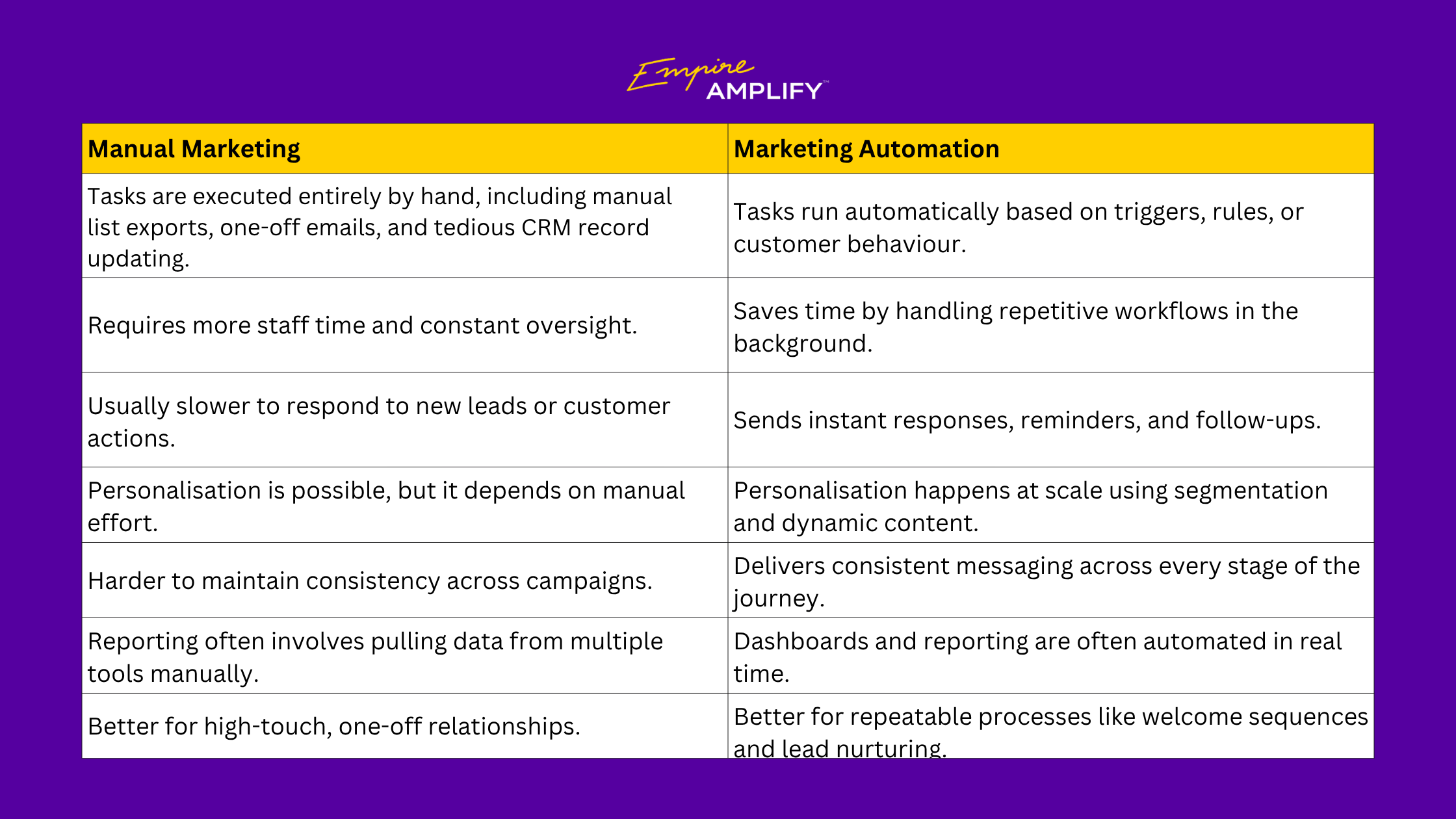
Where Businesses Use Marketing Automation: 5 Areas to Prioritise
Automation can improve most marketing operations, but these five areas deliver the fastest ROI for SMBs.
1. Welcome Email Sequences
Welcome sequences are automated messages sent after a user subscribes, signs up, or buys. They establish expectations, confirm value, and move contacts to the next action (first purchase, profile completion).
Follow these steps in your welcome email sequence:
- Step 1: Trigger an immediate "Opt-in Deliverable" email upon form submission.
- Step 2: Wait 48 hours; trigger a "Brand Story & Core Values" introduction.
- Step 3: Wait 72 hours; trigger a "High-Intent Call to Action or Exclusive Offer.
According to Experian, welcome emails generate eight times higher revenue per email and four times higher open rates than bulk promotional emails, while industry benchmarks show average open rates around 50%.
2. Lead Nurturing Campaigns
Lead nurturing campaigns guide prospects through a staged journey from awareness to purchase using timed, behaviour-driven content. When a prospect downloads an eBook, for example, the system can move them into an interest stage and start a tailored sequence automatically.
Using lead nurturing campaigns helps your business to:
- Keep prospects engaged: Deliver the right content at the right time, instead of relying on one-off follow-ups.
- Improve lead quality: Focus sales attention on contacts who are showing genuine buying intent.
- Shorten the sales cycle: Move prospects toward a decision with relevant education, proof, and reminders.
- Reduce manual follow-up: Automate repeat touches so nothing falls through the cracks.
3. Re-Engagement Campaigns
Re‑engagement campaigns are automated attempts to win back inactive subscribers or customers. These campaigns detect inactivity (no opens, no site visits, no purchases) over a defined window and then trigger a sequence with tailored offers, surveys, or content to rekindle interest.
Using re-engagement campaigns helps your business to:
- Win back inactive contacts: Reach people who have gone quiet before they disappear completely.
- Protect list quality: Remove or re-engage low-activity subscribers so your database stays healthier.
- Improve deliverability: Reduce the risk of sending to dead segments that drag down engagement rates.
- Recover lost revenue: Bring past customers back with a relevant offer, reminder, or update.
- Learn why people disengage: Use surveys or feedback prompts to understand what’s missing.
4. Upsell and Cross-Sell Campaigns
Upsell/cross-sell automations target existing customers with relevant offers after purchase. Triggered by purchase data, product usage, or lifecycle milestones, these workflows increase customer lifetime value without relying on cold acquisition.
Using upsell and cross-sell campaigns helps your business to:
- Increase customer lifetime value: Encourage customers to buy a higher-tier product, add-on, or complementary service.
- Drive repeat revenue: Turn one purchase into a longer-term revenue stream.
- Improve offer relevance: Show customers products or services that match what they already bought.
- Boost retention: Keep your brand top of mind with timely, useful follow-up offers.
- Reduce acquisition pressure: Grow revenue from your existing customer base instead of always chasing new leads.
5. Customer Feedback Workflows
Feedback workflows automate the collection of reviews, NPS, and product feedback at scale. Trigger surveys after key events (delivery, first use, support interaction) and route negative responses to a support queue while promoting positive reviews to public channels.
Using a customer feedback workflow helps your business to:
- Collect feedback consistently: Ask at the right moment instead of hoping customers reply later.
- Spot issues early: Catch negative experiences before they turn into public complaints.
- Generate more reviews: Make it easier for happy customers to share positive feedback.
- Improve products and services: Turn customer responses into usable insight for better decisions.
- Strengthen retention: Show customers you are listening and acting on their feedback.
Frequently Asked Questions
What’s the difference between marketing automation and email marketing?
Email marketing focuses strictly on sending scheduled emails to a list. Marketing automation software, on the other hand, tracks multi-channel user behaviour (website visits, clicks, purchases) to trigger coordinated workflows across email, SMS, CRMs, and targeted ads.
Do small businesses really need marketing automation?
Yes, especially if you want to scale your leads and sales without hiring more staff.
Save Time and Resources with Marketing Automation
Marketing automation replaces manual marketing tasks with repeatable, measurable workflows that lift conversion rates and free staff for strategy and creative work. It’s here to stay, and now is the time to start implementing it in your Australian SMB.
Discover how Empire Amplify can help your business to grow faster with marketing that delivers.
Book a strategic call with us to identify the highest-value automation for your business.
Related Reading: