

Business travel can increase revenue both directly and indirectly by dividing the net financial return (such as revenue generated, pipeline value created, or client retention) by total travel expenses, expressed as a percentage.
According to the Australian Taxation Office (ATO), businesses registered for GST can generally claim 100% input tax credits on eligible domestic business travel expenses, including domestic flights and accommodation, provided they hold a valid tax invoice and the trip serves a clear business purpose.
While international flights and overseas hotel stays are classified as GST-free or outside Australia's tax system, no GST is charged or can be claimed.
Key Takeaways
- Calculate ROI by dividing net travel income by total direct travel costs.
- Claim back GST on domestic Australian flights and short-term hotel stays.
- Foreign flights and overseas accommodations do not carry Australian GST.
What is the ROI of Business Travel?
The return on investment (ROI) of business travel is the return a business gets from a trip compared with what it costs. That return might be a signed contract, a stronger client relationship, a supplier discount, a partnership opportunity, or a faster sales pipeline.
According to a survey from Oxford Economics, for every dollar invested in business travel, companies generate an average of $12.50 in incremental revenue and $3.80 in net profit.
How to Calculate Your Business Travel ROI?
To calculate the ROI of business travel, you should follow this four-step process to better understand its importance to your development and future plans.
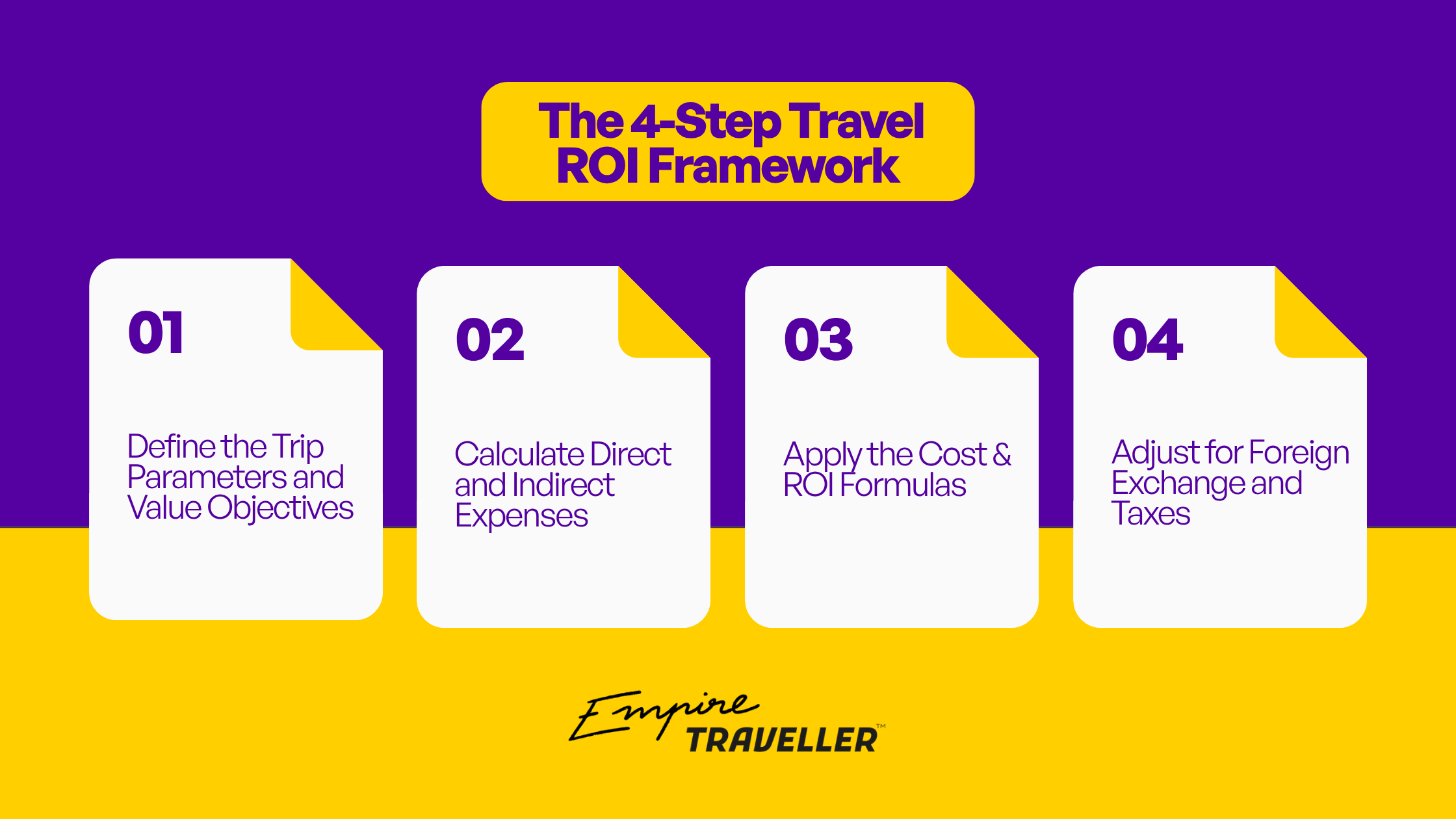
Step 1: Define the Trip Parameters and Value Objectives
Establish the scope and financial goals of the trip before setting budgets:
Destination: Local, domestic, or international (impacts of GST, exchange rates, and per diem rates).
Duration and Travelers: Number of days, nights, and participating employees.
Primary Objective: Identify the revenue target, pipeline stage goal, or contract value at stake.
Step 2: Calculate Direct and Indirect Expenses
Break down all associated travel costs into distinct categories:
Transportation: Flights, train fares, vehicle mileage reimbursement, rental cars, fuel, parking, and rideshares.
Accommodation: Nightly room rates plus applicable lodging taxes or fees.
Meals & Incidentals: Standard employee daily meal allowances while away overnight.
Client Entertainment: Host dinners, drinks, or events.
Visas and Health: Entry authorisations (e.g., US ESTA, UK ETA), travel insurance, and vaccinations.
Technology and Admin: Mobile roaming fees, local eSIMs, in-flight Wi-Fi, and conference registration fees.
Step 3: Apply the Cost & ROI Formulas
First, sum your total trip expenses:
Total Travel Cost = T + (H * N) + (M * D * P) + V + E + C
Where:
T = Transportation costs
H = Nightly hotel rate
N = Number of nights
M = Daily meal rate
D = Number of days
P = Number of travelers
V = Visas and insurance
E = Event and entertainment costs
C = Contingency buffer (5%–10%)
Next, calculate the total percentage return:
Travel ROI (%) = [ (Attributable Value Generated - Total Travel Cost) / Total Travel Cost ] * 100
Step 4: Adjust for Foreign Exchange and Taxes
Deduct claimable GST input tax credits (1/11th of eligible domestic GST-inclusive spend) on your Business Activity Statement (BAS) to evaluate your Net ROI.
Example ROI Breakdown (Sydney to Melbourne Trip)
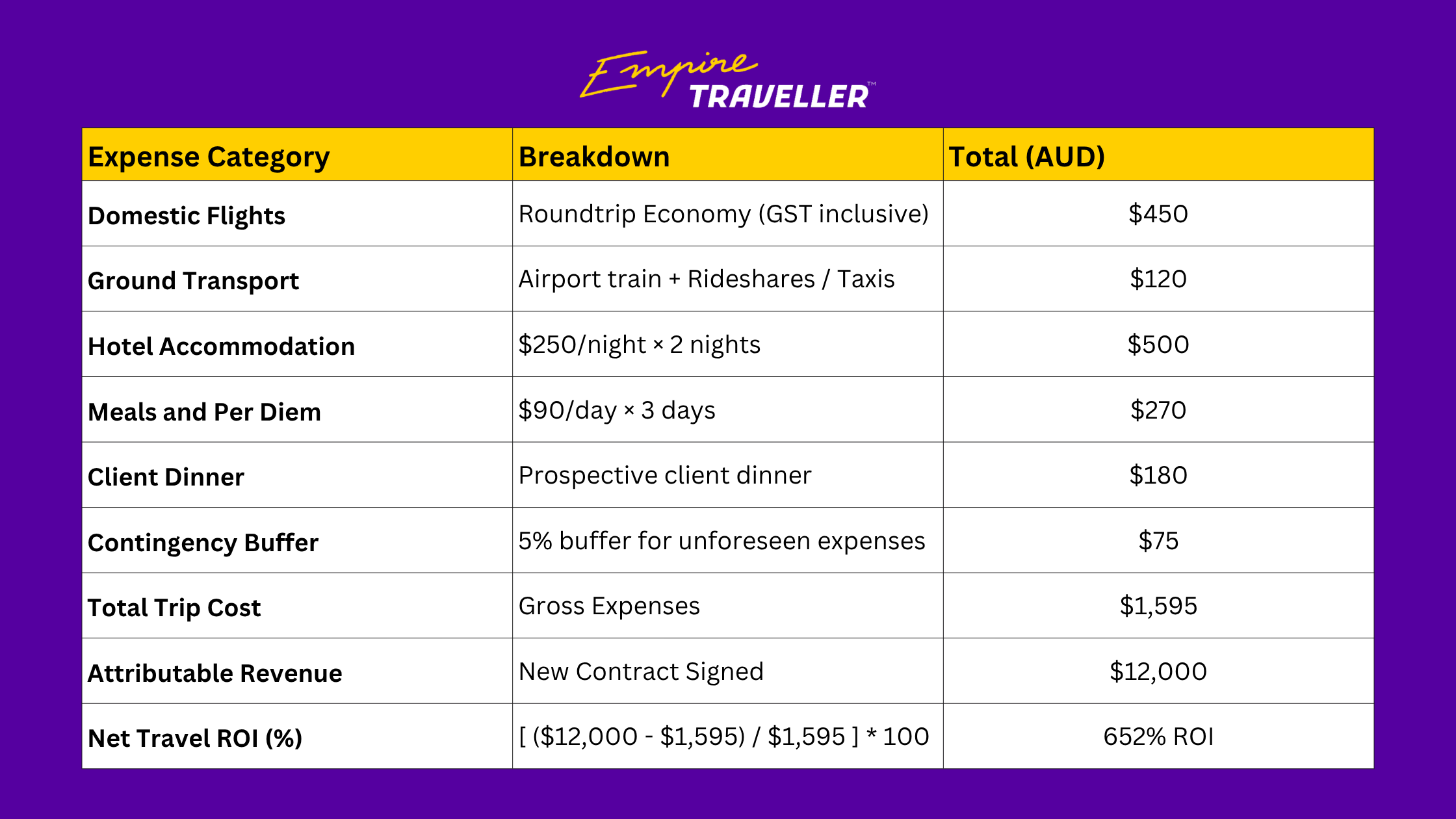
Under ATO guidelines, meal entertainment provided to clients is generally non-deductible for GST input tax credits unless subject to Fringe Benefits Tax (FBT).
Can You Claim GST on Flights and Hotels for Business in Australia?
Registered Australian businesses can claim GST input tax credits on eligible domestic business flights and accommodation, provided they hold a valid ATO tax invoice. However, GST rules differ significantly between domestic and international travel.
Claimable Expenses
- Domestic Flights: Standard domestic airfares within Australia carry 10% GST.
- Domestic Accommodations: Hotels, motels, and serviced apartments in Australia.
- Local Transport: Australian taxi, rideshare, bus, and train expenses.
- Domestic Meals and Incidentals: Meals and work-related incidentals incurred during overnight business travel for employees.
Non-Claimable Expenses
- International Flights: Overseas flights departing from or arriving in Australia are classified as GST-free.
- Domestic Legs on International Tickets: Domestic flights booked together or cross-referenced as part of an international itinerary are GST-free.
- Overseas Accommodation: Lodgings outside Australia fall outside Australian GST jurisdiction.
- Client Meal Entertainment: Restaurant meals with clients are generally blocked from GST claims.
Frequently Asked Questions
How do I claim GST on domestic vs international business flights in Australia?
You claim 10% GST on domestic flights via your BAS using standard tax invoices from airlines. International flights are GST-free under ATO law, meaning no Australian GST is charged or claimable. Domestic legs on international tickets are also GST-free.
Can I claim GST on overseas hotel accommodation?
No, you cannot claim Australian GST on overseas hotel accommodation because international lodgings fall outside Australian GST jurisdiction. However, the total cost remains fully tax-deductible as a business expense on your annual tax return.
Make the Most of Your Business Trip with Empire Traveller
Business travel can be a real growth lever when it’s strategically planned and accurately tracked. If you want to simplify booking, tracking, and measuring business travel expenses, create an account on Empire Traveller and make the most of your business trip.
Related Reading:
How to Prepare for a Conference as an Australian Business Traveler