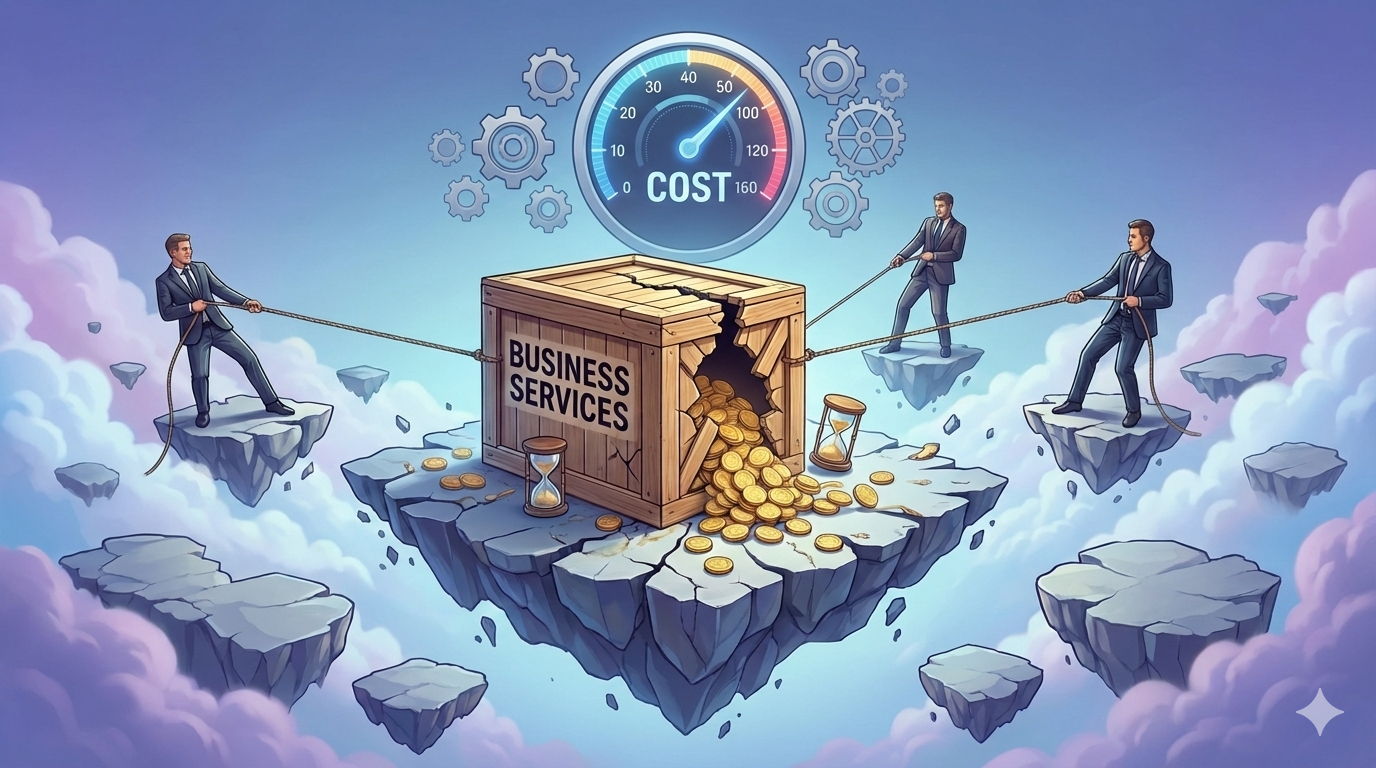

The modern business landscape is often described as a gold mine of specialised solutions.
For every niche problem, there is a niche provider. For every operational hurdle, there is a boutique agency or a specialised SaaS platform promising a quick fix. On the surface, this sounds like progress, but for the Small to Medium Enterprise (SME) owner, it has birthed a different kind of monster.
This is the era of fragmentation.
It is a state where a business owner acts as the weary glue, desperately trying to hold together a dozen different service providers who neither speak to each other nor understand the business's holistic goals. We are taught to find the "best of breed" for every individual department, yet we rarely account for the friction that occurs at the intersections.
When your marketing agency doesn't understand your lending constraints, and your insurance broker is unaware of your HR expansion plans, the result is not excellence.
The result is a silent, compounding tax on your growth.
The Architectural Flaw of the Modern SME
Most businesses do not start with a fragmented service model by design; they arrive there through a series of tactical reactions.
In the early days, you hire an accountant because you need to stay compliant. Later, you hire a marketing freelancer because you need leads. Then comes the insurance broker, the HR consultant, and the utility provider.
Each decision is made in a vacuum.
By the time the business reaches a certain scale, the founder realises they are no longer running a company; they are managing a sprawling web of disparate relationships. This architectural flaw is what we call the "Vendor Stack Crisis," where the complexity of managing the stack outweighs the benefits of the individual services.
The Myth of Specialist Superiority
The prevailing wisdom suggests that by picking a different specialist for every function, you are optimising your business for high performance.
However, this ignores the fundamental law of systems: the performance of a system is not the sum of its parts, but the product of its interactions. If your "specialist" lending partner provides you with capital that your "specialist" marketing team doesn't know how to deploy efficiently, the specialisation is wasted.
- Siloed Intelligence: Providers only see 10% of your business, leading to incomplete advice.
- Communication Overhead: You become the primary router of information between parties.
- Misaligned Incentives: Each vendor optimises for their own KPI, not your bottom line.
- Redundant Audits: You provide the same data points to five different entities repeatedly.
The Cognitive Load: The Founder’s Hidden Tax
Perhaps the most significant—yet least discussed—cost of fragmented services is the cognitive load placed on the business owner.
Psychologists often speak of "context switching," the mental cost of jumping between unrelated tasks. For an SME owner, this cost is extreme. One hour is spent discussing professional indemnity insurance; the next is spent reviewing a digital marketing funnel; the next is a conversation about staff retention strategies.
Decision Fatigue and the Zeigarnik Effect
When you manage seven different service providers, you are constantly holding "open loops" in your mind.
The Zeigarnik Effect suggests that humans remember uncompleted or interrupted tasks better than completed ones. A fragmented business model creates a perpetual state of uncompleted tasks because the business owner is always waiting for a response from one vendor to inform the next.
This leads to chronic decision fatigue.
By the time a business owner needs to make a high-stakes strategic decision, their mental energy has been depleted by the minutiae of coordinating middle-men. They are essentially paying for "premium" services but receiving a diluted version of them because the integration work falls back on their shoulders.
- Mental Bandwidth: The constant need to explain your business vision to new vendors.
- Focus Fragmentation: Being pulled away from core operations to handle administrative vendor friction.
- The Oversight Burden: The underlying anxiety that something is falling through the cracks because no one has a "birds-eye view."
The Financial Erosion of Disconnected Vendors
Beyond the mental toll, the literal financial cost of fragmentation is staggering.
When services are purchased in isolation, the business loses all sense of economy of scale. You are a single account to an insurance firm, a single client to a marketing agency, and a single customer to a utility provider.
In a fragmented model, there is no "portfolio" power.
The Redundancy Trap
Fragmentation almost always leads to redundant spending.
For instance, you might be paying for a high-level HR consultant who provides templates that your legal team is also charging you to review. Or perhaps you are paying for marketing software that includes features already covered by your CRM, which was set up by a different IT provider.
Without a central ecosystem to audit these overlaps, the "SaaS and Service Leak" can account for up to 15-20% of an SME’s operating budget.
The Lack of Negotiating Leverage
Individual SMEs often feel they have no power against large utility companies or insurance conglomerates.
This is true when you stand alone.
Fragmented services keep businesses small in the eyes of the provider. When you occupy an ecosystem, however, the dynamic changes. Fragmentation is essentially the voluntary surrender of collective bargaining power.
- Hidden Fees: Specialised vendors often hide margins in complex contracts that aren't compared against the market.
- Unused Features: Paying for "full-service" tiers when only 20% of the service is relevant to your current stage.
- Procurement Waste: The billable hours spent searching for, vetting, and onboarding new providers.
The Data Silo Crisis: Operating Without a Central Nervous System
In the digital age, data is the most valuable asset an SME possesses.
However, in a fragmented service model, your data is scattered across half a dozen different proprietary platforms. Your marketing data lives with the agency; your financial health data lives with the lender; your risk profile lives with the insurer.
None of these data sets talk to each other.
The Risk of Inaccurate Forecasting
When a business owner wants to forecast growth, they need a holistic view of their levers.
If you are looking to scale, you need to know if your current insurance covers the increased liability, if your HR can handle the headcount, and if your cash flow can support the marketing spend. If getting the answers to these three questions requires three separate phone calls and four different logins, the data is effectively useless for real-time decision-making.
Fragmentation turns data into a liability—something that must be managed—rather than an asset that provides clarity.
The Security Vulnerability
Every new vendor you bring on is a new point of failure.
In a fragmented model, you are sharing sensitive business data, employee records, and financial statements with multiple entities, each with their own security protocols (or lack thereof). The "surface area" for a potential data breach increases with every disconnected service you add to your stack.
- Data Fragmentation: The inability to see a single "truth" regarding business performance.
- Information Asymmetry: Vendors knowing more about their specific silo than you do about the whole.
- Audit Friction: The nightmare of gathering documentation from six sources for a tax or compliance event.
The Relationship Deficit: Transactional vs. Transformational
The most "human" cost of fragmented services is the loss of a genuine partnership.
Most service providers today operate on a transactional basis. They are there to fulfill a specific contract. If you succeed, that’s great; but if you fail due to a factor outside their specific silo, it’s not their concern. The marketing agency will happily take your money even if your internal operations are too broken to handle the leads they generate.
The Concierge Gap
What SMEs actually need is a "concierge" experience—a single point of contact that understands the soul of the business.
In a fragmented model, the "concierge" is the business owner. But the business owner is too close to the fire to be objective. They need a partner who can look at the "business health" as a whole and say, "Before you spend more on marketing, we need to fix your insurance coverage and secure your lending line."
Fragmentation eliminates this cross-functional wisdom.
The Trust Deficit
When you have ten vendors, you have ten different entities trying to "up-sell" you.
It becomes difficult to know whose advice is truly in your best interest. Is the lender suggesting more capital because you need it, or because they have a quota? In a unified ecosystem, the incentive structure changes. The goal becomes the health of the entire business, not the maximisation of a single contract.
- Disconnected Advice: Receiving suggestions that are technically sound but strategically irrelevant.
- The "Not My Job" Syndrome: When a problem falls between the gaps of two vendors, and neither takes responsibility.
- The Onboarding Loop: The exhaustion of having to re-educate new providers on your brand values and history.
Vertical Fragmentation: A Case Study in Friction
To understand the true cost, we must look at how fragmentation plays out across specific business functions.
Lending and Finance
When lending is disconnected from the rest of the business, it becomes a "emergency" activity rather than a strategic one. Most SMEs look for lending when they are already in a cash-flow crunch.
If the lender was part of a broader ecosystem, they would see the "health assessment" of the business months in advance. They would see the marketing growth and the HR expansion and could provide proactive capital. In a fragmented world, you pay the "desperation premium."
Marketing and Growth
Marketing agencies often operate in a vacuum of "ROAS" (Return on Ad Spend).
But ROAS doesn't account for the cost of goods, the pressure on HR to hire more staff, or the increased insurance premiums that come with higher turnover. A fragmented marketing strategy might "succeed" on paper while actually putting the business under immense operational strain.
Insurance and Risk Management
Insurance is perhaps the most fragmented of all services.
Most brokers check in once a year at renewal time. In the intervening 11 months, the business might change significantly—new equipment, new markets, new risks. Because the insurer is not part of the business's daily "ecosystem," the business is often either over-paying for coverage they no longer need or, more dangerously, under-insured for risks they've recently acquired.
- Utilities: The "set and forget" trap where businesses overpay for years because no one is auditing the contract against the market.
- HR and People: Managing staff without a clear link to the financial growth plan of the company.
- Travel and Admin: Small leaks in travel spending that go unnoticed because they aren't integrated into the main accounting oversight.
The Evolution of the Business Service Ecosystem
We are witnessing a shift in the business world, moving away from "aggregation" and toward "integration."
In the past, a business owner might find a directory of services (aggregation). Today, the gold standard is the "ecosystem." This is a model where multiple brands and services operate independently as experts, but feed into a single, trusted pathway.
The Power of a Single Entry Point
The value of a single entry point cannot be overstated.
It is the difference between having ten keys for ten doors and having a master key. When a business owner enters an ecosystem, their "Business Health Assessment" follows them. They don't have to explain their revenue model to the marketer, then again to the insurance broker, then again to the HR lead.
The intelligence is shared. The friction is removed.
The Guided Onboarding Experience
Fragmentation thrives on "self-service" models where the burden of choice is on the customer.
A membership-based ecosystem replaces this with a guided onboarding process. This acknowledges that the business owner doesn't always know what they need. They know they have a "pain," but they might misdiagnose the cause. A guided process acts as a diagnostic tool, ensuring the business accesses the right service at the right time, rather than just the service with the loudest marketing.
Reclaiming the Founder's Purpose
Why do people start businesses?
Very few founders start a company because they enjoy managing vendors. They start because they have a product to build, a service to provide, or a vision to realise. Fragmentation is the thief of that purpose. It turns visionaries into administrators.
The "Time Back" Equation
If you could quantify the time spent on vendor management, email threads, contract reviews, and data reconciliation, it would likely account for hours every week.
Over a year, that is hundreds of hours.
If a founder’s time is valued at $200 an hour, the "fragmentation tax" is costing the business tens of thousands of dollars in pure labor, even before you look at the service fees themselves. Reclaiming that time is the single greatest ROI a business can achieve.
- Focus on Core Competencies: Doing what actually generates revenue.
- Strategic Thinking: Having the mental space to look at the three-year plan.
- Emotional Resilience: Reducing the "noise" that leads to burnout.
The SME of the Future: Lean, Integrated, and Agile
The business of the future doesn't look like a sprawling mess of disconnected apps and agencies.
The future SME is lean. It operates within a central ecosystem that provides a "single pane of glass" view of its operations. It values trust over "best-of-breed" complexity. It understands that a 5% increase in integration is often more valuable than a 10% increase in a single department's performance.
From Procurement to Partnership
We are moving into an era where "procurement" is being replaced by "membership."
Membership implies a long-term, mutually beneficial relationship. It implies that the provider is invested in the member’s overall health. In this model, the "true cost" of business services becomes transparent, predictable, and—most importantly—optimised for growth.
The Confidence Factor
Ultimately, the cost of fragmentation is a loss of confidence.
When things are scattered, you're never quite sure if you're making the right move. You're never quite sure if your insurance is sufficient or if your marketing is profitable. A unified ecosystem provides the "Confidence of One." One source of truth. One partner. One path forward.
- Clarity: Knowing exactly where the business stands across all verticals.
- Speed: Moving from "problem identified" to "solution implemented" without the vendor-search lag.
- Stability: An ecosystem that grows with you, rather than a stack that breaks as you scale.
The Path Forward: Breaking the Fragmentation Loop
Breaking the cycle of fragmentation requires a fundamental shift in mindset.
It requires the business owner to stop looking for "tools" and start looking for an "infrastructure." It's the realisation that the business needs a central nervous system to coordinate the limbs.
The true cost of fragmented business services is not just the money wasted or the time lost. It is the potential that remains untapped because the founder is too busy managing the chaos of the present to build the brilliance of the future.
By centralising the entry point into specialised services—from lending to HR, from insurance to marketing—the SME can finally stop acting as the glue and start acting as the architect.
The transition from a fragmented stack to a unified ecosystem is the moment a business stops surviving and starts thriving. It is the moment the "invisible drain" is plugged, and the founder’s energy is finally redirected toward the vision that started it all.
In the end, the most valuable thing an integrated ecosystem offers isn't just better services.
It is the freedom to lead.